Voice Ai
Using AI Employee Solutions to Boost Operational Efficiency and Business Productivity

AI Employee solutions— sometimes called virtual AI assistants or agentic AI — are software-driven systems that automate routine business tasks, capture leads, and maintain customer interactions around the clock. These AI Employees combine components such as voice recognition modules, NLP engines, scheduling engines, and CRM integration to reduce manual work and improve throughput across sales, marketing, and operations. Organizations use voice AI, AI chatbots, content AI, and workflows AI to shorten response times, eliminate repetitive tasks, and increase conversion rates, making AI a practical lever for operational efficiency. This article explains how AI improves business automation, catalogs key AI Employee features and how they map to outcomes, and shows how content and funnel automation accelerate growth. You will also find practical scheduling and workflow advice, measurement frameworks for ROI, and problem–solution mappings for common SMB pain points in 2024, with concrete examples of implementation that prepare you to evaluate an AI Employee for immediate deployment. The following sections cover mechanisms, feature breakdowns, content optimization, scheduling and productivity, measurable ROI, and the problems AI can solve for growing businesses.
How Does AI Improve Operational Efficiency in Business Automation?
AI improves operational efficiency by automating repetitive tasks, providing data-driven insights, and enabling continuous customer interactions, which together reduce labor hours and increase throughput. The mechanism combines task automation (RPA-style execution), natural language understanding for customer interactions, and workflow orchestration that applies conditional logic to route work automatically. The result is fewer handoffs, lower error rates, and more consistent service levels across channels such as voice, chat, and social. These capabilities directly shorten cycle times for sales and support processes and free staff to focus on high-value activities that require judgment. Understanding which tasks are best suited for AI automation clarifies where to start and how to sequence implementation to achieve fast wins.
What Tasks Can AI Employees Automate to Save Time and Costs?
AI Employees automate administrative tasks, lead qualification, scheduling, and routine support so teams spend less time on manual updates and more on strategic work. Common automations includeCRM data entryand enrichment, automated follow-up sequences via email or SMS, inbound lead triage through conversational AI, and booking management that syncs with calendars to prevent duplicate scheduling. These automations reduce manual errors, accelerate lead response time, and lower the cost per contact by eliminating repetitive human touchpoints. Organizations typically see the fastest returns when they automate high-volume, low-complexity tasks that previously consumed the majority of staff time, which then permits staff redeployment to revenue-generating activities.
How Does AI Workflow Automation Enhance Business Productivity?
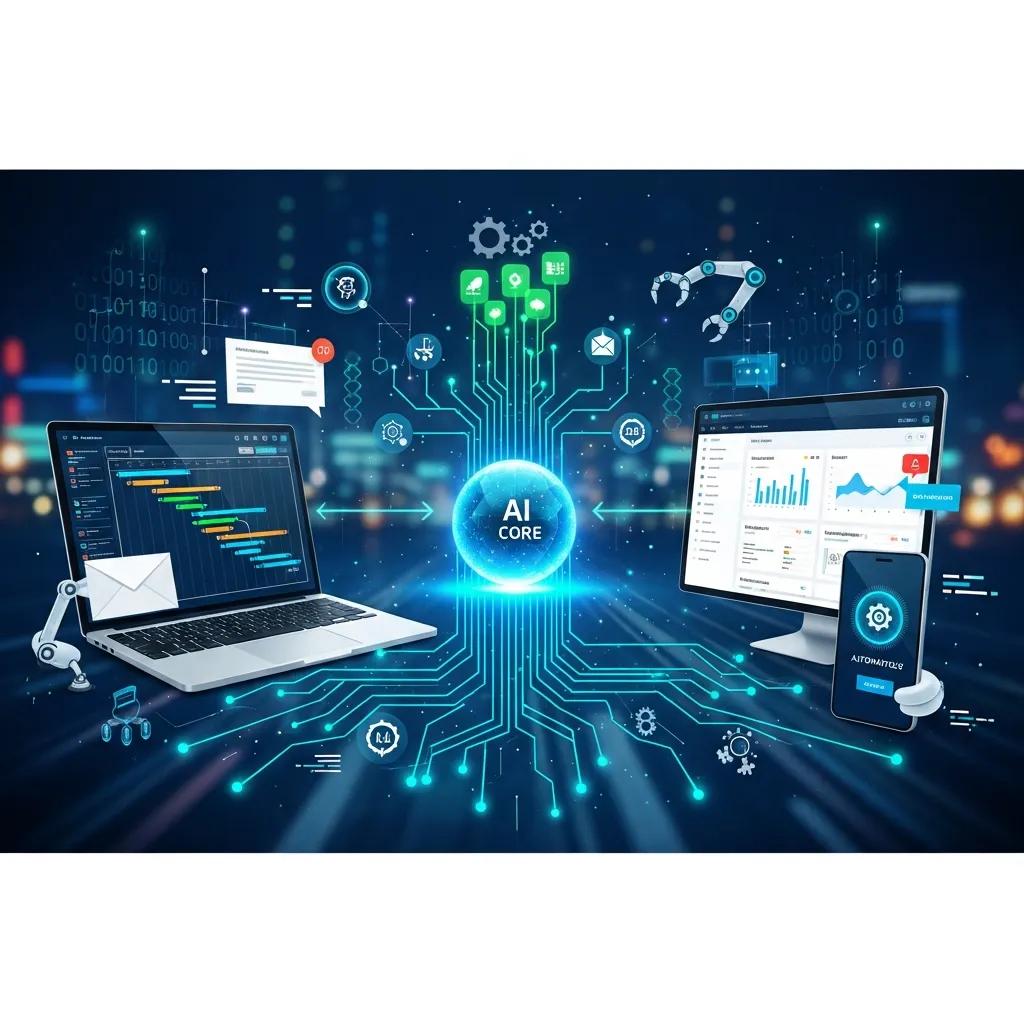
AI workflow automation enhances productivity by orchestrating multistep processes with conditional branching, exception handling, and integrated system updates that remove manual handoffs between teams. Workflows trigger on events — a form submission, an inbound call, or a review — and then run sequences that qualify a lead, schedule appointments, update a CRM, and notify human agents only when escalation is required. This reduces queue times, minimizes task duplication, and enforces business rules consistently across channels. By combining workflow automation with analytics, companies can continuously optimize flow paths and reduce time-to-resolution for customer requests, which compounds productivity gains as volume scales.
What Are the Key Features of AI Employee Solutions for Operational Efficiency?
AI Employee solutions bundle capabilities like voice AI, chatbots, scheduling engines, content generation, and workflow automation to operate as persistent, multi-channel team members that increase capacity without proportional headcount increases. Feature sets typically include an AI Voice Agent for inbound calls, an AI Website Chat Widget for real-time qualification, conversational AI for social channels, Reviews AI for reputation management, Calendars and Booking Management for appointments, Funnels AI and Content AI for marketing automation, and Workflows AI to connect these capabilities into repeatable processes. Each feature plays a role in capturing leads, converting prospects, and reducing manual follow-up work while maintaining consistent brand messaging. Mapping these features to measurable benefits helps prioritize which capabilities to deploy first and how they will affect KPIs like leads captured, response time, and conversion rates.
AI Employee features mapped to benefits are summarized in the following table, which helps compare capability to expected operational impact.
FeatureCapabilityBusiness BenefitVoice AINatural language call handling and qualification24/7 lead capture and reduced missed callsAI Website Chat WidgetReal-time chat qualification on siteFaster response time and higher engagementCalendars & Booking ManagementAutomated booking and calendar syncFewer scheduling conflicts and more confirmed appointmentsWorkflows AIConditional process orchestrationReduced handoffs and consistent task completion
This table clarifies how feature selection ties directly to measurable operational outcomes and sets the stage for prioritizing implementation.
The section below enumerates specific ways voice, chat, and conversational AI support lead capture and support; these feature explanations illustrate concrete KPI improvements and integration patterns.
How Does Voice AI Enable 24/7 Customer Interaction and Lead Capture?
Voice AI uses natural language understanding to answer calls, qualify intent, collect contact details, and route or log interactions into a CRM, allowing businesses to capture opportunities that occur outside normal hours. The mechanism involves voice recognition modules that transcribe calls, an NLP engine that extracts intent and entities, and integrations with booking engines or CRMs to schedule follow-ups or create leads automatically. Voice AI reduces missed calls, shortens response time, and increases lead capture volume by handling routine qualification and handoffs efficiently. KPI examples to monitor include calls handled per month, percentage of calls converted to qualified leads, and reduction in after-hours missed opportunities, which together reveal the upfront impact of voice automation.
What Role Do AI Chatbots and Conversational AI Play in Customer Support?
AI chatbots and conversational AI deliver instant answers to FAQs, triage issues, qualify leads, and escalate complex requests to human agents when necessary, functioning across web and social channels to sustain high availability. These systems use conversation flows to gather necessary information, update CRM records, and trigger follow-up workflows such as appointment confirmations or nurture sequences. Measurement focuses on response time, resolution rate, and handoff latency to human agents; improved metrics here directly lower support costs and improve customer satisfaction. When combined with voice and reviews AI, chatbots form a multi-channel front line that preserves a consistent brand voice and captures interaction metadata for continuous optimization.
AI Chatbots in Business: Enabling Instant Support and Automating Routine Tasks
This paper details three case studies of chatbot implementation by Umni customers. Umni is a no-code platform for the development, administration, and training of AI chatbots. These case studies demonstrate how chatbots benefit businesses, employees, and customers by providing immediate assistance and automating routine processes.
AI chatbots as a customer service and support tool, 2021
How Can AI Tools Optimize Content Creation and Marketing Automation?

Content AI and Funnels AI optimize marketing by automating the generation of campaign assets, personalizing messaging at scale, and orchestrating nurture sequences that move prospects through conversion paths without manual intervention. Content AI can produce draft blog posts, segmented email sequences, and multiple social variations quickly, while Funnels AI uses lead scoring and automated triggers to determine which content and follow-ups a prospect receives. The combination reduces time to publish, increases content variation for A/B testing, and ensures timely touches that align with buyer intent, which in turn improves conversion rates and marketing efficiency. To evaluate content AI, teams should measure time saved per asset, engagement lift from personalized content, and conversion changes attributable to automated nurture flows.
The following table compares content AI functions, output types, and typical time savings for marketing teams to illustrate trade-offs and use cases.
Content AI FunctionOutput TypeTypical Time SavedBlog DraftingLong-form article drafts6–12 hours per postEmail Sequence GenerationSegmented nurture emails2–4 hours per campaignSocial Content VariationsMultiple post variants1–3 hours per campaign
This comparison highlights where automation yields immediate efficiency and where human editing remains essential for quality and brand alignment.
Practical ways to implement AI-driven funnels include automated segmentation, dynamic content insertion, and predictive follow-ups; the list below outlines starting steps to operationalize AI content and funnels.
Define target segments: Identify high-value personas and map ideal messaging sequences.
Automate asset generation: Use Content AI to create base drafts for emails, blogs, and social posts.
Orchestrate nurture flows: Configure Funnels AI to trigger messages based on behavior and lead score.
These steps help teams move from experimentation to repeatable campaigns, and they naturally lead to considerations for scheduling and task orchestration handled by AI Employees.
How Does AI Employee Enhance Workflow Optimization and Scheduling?
AI Employees improve scheduling and task routing by synchronizing bookings across calendars, sending automated confirmations and reminders, and reallocating tasks based on staff availability and skill profiles. Scheduling engines reduce double-bookings and enable 24/7 self-service booking that ties directly into staff calendars and resource pools, lowering administrative overhead and decreasing no-show rates through automated reminders. Workflows then hand tasks to the correct team member with contextual information captured during intake, which shortens ramp time and preserves service quality. Designing workflows with exception paths and human escalation rules ensures that automation increases capacity without sacrificing control over complex cases.
What Are the Benefits of AI-Powered Scheduling and Appointment Management?
AI-powered scheduling and appointment management reduce friction for customers and staff by offering instant booking, automatic confirmations, and smart rescheduling that considers resource constraints and priorities. The system integrates with calendars to show real-time availability, automatically confirms appointments, and sends reminders that cut no-show rates, while also enabling follow-up tasks such as pre-appointment forms or post-visit surveys. Measuring bookings per week, no-show reduction percentage, and time saved on scheduling tasks demonstrates clear ROI and supports further automation expansion. These capabilities create a smoother customer experience and allow staff to focus on delivering services rather than coordinating logistics.
How Does AI Improve Employee Productivity Through Task Automation?
AI improves employee productivity by automating low-value activities such as data entry, routine follow-ups, and basic triage, while presenting prioritized task lists that help staff address the highest-impact work first. Automated routing assigns tasks to the right person based on rules and availability, and the system updates CRMs and workflows automatically after each interaction, reducing manual administrative time. By freeing employees from repetitive burden, AI enables them to allocate attention to tasks that require creativity and complex decision-making, which enhances overall productivity and job satisfaction. The net effect is a shift in employee time from transactional work toward strategic contributions that drive growth.
What Are the Measurable ROI and Cost Reduction Benefits of Using AI Employees?
AI Employees generate measurable ROI through increased leads captured, faster response times, higher conversion rates, and reduced labor costs tied to repetitive tasks. Quantitative benefits often include percentage uplift in conversion, hours saved per week, and lower marginal cost per interaction as volume grows. For example, some productized AI Employee bundles report conversion improvements that translate into up to a 30 percent increase in sales from faster lead capture and optimized follow-ups, demonstrating how automation can influence top-line results directly. To evaluate these gains, businesses should track before-and-after baselines for leads captured, conversion rate, response time, and labor hours devoted to routine processes.
Below is a practical EAV-style table that compares ROI impact across common metrics and provides estimated value ranges for monthly impact assessments.
MetricChangeEstimated Monthly ValueLeads Captured+20–50%+50–300 leads (depending on volume)Conversion Rate+10–30%Revenue uplift proportional to average saleHours Saved (admin)−30–60%50–200 staff hours savedCost per Interaction−20–50%Significant savings on repetitive tasks
This table helps stakeholders quantify potential savings and prioritize AI Employee features that yield the largest operational returns.
How Can Businesses Track AI Efficiency and Resource Optimization?
Businesses can track AI efficiency with KPIs such as leads captured from AI channels, average response time, conversion rate by channel, and hours saved on administrative tasks, using dashboards that draw data from CRMs and analytics platforms. Establishing pre-implementation baselines and running A/B tests on automated workflows provides clarity on incremental impact, while scheduled reporting ensures leadership sees trend lines and exceptions. Implementing user-level monitoring also surfaces where human intervention still adds value, enabling continuous refinement of automation rules. These measurement practices provide the evidence needed to scale AI investments responsibly and prioritize high-impact automations.
How Does AI Scalability Support Business Growth and Operational Expansion?
AI scales by handling more interactions without a matching increase in headcount, lowering the marginal cost per additional lead or customer contact and enabling geographic or channel expansion with limited incremental staffing. Elastic handling of volume spikes—such as seasonal demand or marketing campaign bursts—keeps response times steady and captures opportunities that would otherwise be lost. As volume grows, AI systems generate richer interaction data that improves models and routing logic, creating a virtuous cycle of efficiency and accuracy. This scalability supports expansion plans by providing reliable coverage across channels and time zones while preserving service consistency.
At this point, businesses evaluating AI Employee solutions often look to productized bundles that map features to implementation paths and expected metrics;Carbon Marketing Inc.'s Carbon AI and its "AI Employee" concept are examples of bundled offerings that combine voice AI, website chat, reviews AI, calendars and booking management, conversation AI, funnels AI, content AI, and workflows AI into an integrated stack. Those evaluating such productized options should review feature-to-benefit mappings and expected outcomes before scheduling demos or checking pricing pages to validate fit with their KPIs.
What Are Common Business Challenges Solved by AI Employee Solutions?
AI Employee solutions address backlog from repetitive administrative work, improve lead management by reducing response latency, and enhance customer experience through consistent, instant interactions across voice, chat, and social channels. By automating routine functions like CRM updates, appointment confirmations, and first-level support, AI reduces operational bottlenecks and enables faster decision-making. The result is improved satisfaction for customers who expect immediate responses and better utilization of human staff who can focus on complex tasks. The following problem-solution mappings illustrate common scenarios and practical AI remedies for SMBs aiming to increase efficiency without large hiring surges.
How Does AI Address Repetitive Administrative Tasks and Lead Management?
AI replaces repetitive administrative tasks such as data entry, lead scoring, and follow-up sequences with automated processes that capture and enrich lead data, apply scoring rules, and trigger appropriate nurture flows. These automations reduce manual backlog and human error while ensuring leads receive timely touches that increase the chance of conversion. A practical mini-case: automating intake and scoring for web leads can convert a 48-hour manual follow-up process into immediate automated qualification and same-day outreach, saving dozens of weekly staff hours. These efficiency gains free teams to close higher-value deals and maintain more consistent pipeline hygiene.
How Does AI Improve Customer Experience and Instant Client Response?
AI improves customer experience by delivering faster initial contacts, consistent messaging, and personalized interactions across multiple channels, which meets modern expectations for instant replies and availability. Conversational AI can greet, qualify, and route customers immediately while content AI personalizes follow-ups and Funnels AI ensures timely nurturing sequences. Together, these systems reduce friction and increase perceived responsiveness, which boosts satisfaction and conversion likelihood. For businesses that prioritize reputation and conversion, integrating AI as an answering service and lead capture engine creates a reliable, always-on customer interface that complements human agents for complex or high-value interactions.
Frequently Asked Questions
What types of businesses can benefit from AI Employee solutions?
AI Employee solutions are versatile and can benefit a wide range of businesses, from small startups to large enterprises. Industries such as retail, healthcare, finance, and customer service can leverage AI to automate repetitive tasks, enhance customer interactions, and improve operational efficiency. By implementing AI, businesses can streamline processes, reduce costs, and enhance customer satisfaction, making it a valuable tool for any organization looking to optimize its operations and scale effectively.
How can businesses ensure successful implementation of AI Employee solutions?
Successful implementation of AI Employee solutions requires careful planning and alignment with business goals. Organizations should start by identifying specific pain points that AI can address, such as lead management or customer support. Engaging stakeholders, providing adequate training, and setting clear KPIs for measuring success are crucial steps. Additionally, conducting pilot programs can help refine processes and ensure that the AI systems integrate smoothly with existing workflows, ultimately leading to a more effective deployment.
What are the potential challenges of using AI in business operations?
While AI offers numerous benefits, businesses may face challenges such as data privacy concerns, integration issues with existing systems, and resistance to change from employees. Ensuring data security and compliance with regulations is essential, as is providing training to staff to ease the transition. Additionally, businesses must be prepared to address any technical difficulties that arise during implementation and continuously monitor AI performance to make necessary adjustments for optimal results.
How does AI impact employee roles and job satisfaction?
AI can significantly impact employee roles by automating mundane tasks, allowing staff to focus on higher-value activities that require creativity and critical thinking. This shift can lead to increased job satisfaction as employees engage in more meaningful work. However, it is essential for organizations to communicate the benefits of AI clearly and provide training to help employees adapt to new technologies, ensuring they feel supported and valued in their evolving roles.
What metrics should businesses track to measure the success of AI Employee solutions?
To measure the success of AI Employee solutions, businesses should track key performance indicators (KPIs) such as lead conversion rates, response times, customer satisfaction scores, and hours saved on administrative tasks. Monitoring these metrics helps organizations assess the impact of AI on operational efficiency and customer experience. Additionally, tracking the cost per interaction and overall ROI can provide insights into the financial benefits of implementing AI solutions.
Can AI Employee solutions be customized for specific business needs?
Yes, AI Employee solutions can often be customized to meet the unique needs of different businesses. Many AI platforms offer flexible configurations that allow organizations to tailor features such as chatbots, workflow automation, and content generation to align with their specific processes and goals. Customization ensures that the AI tools effectively address the particular challenges a business faces, enhancing their overall effectiveness and integration into existing workflows.
Conclusion
Implementing AI Employee solutions can significantly enhance operational efficiency and boost productivity by automating routine tasks and improving lead management. These systems not only streamline processes but also elevate customer experiences through consistent and instant interactions. By leveraging AI, businesses can focus on strategic initiatives that drive growth and innovation. Discover how our tailored AI solutions can transform your operations today.
